
Ehrenberg-Bass: Narrow targeting ‘counter-productive’ to B2B growth
For a B2B marketer looking to acquire new customers and drive business growth, it might seem common sense to target a niche group of customers whose needs directly align with the product or service on offer.
However, according to a major new study by Ehrenberg-Bass Institute’s Professor Jenni Romaniuk for the LinkedIn B2B Institute, that’s a “counter-productive” approach. The best way to drive B2B business growth is to target all customers within the brand’s category.
Professor Romaniuk’s study confirms that the marketing law of duplicate purchase applies to B2B markets just as much as it applies to B2C. This means B2B brands share customers with and acquire customers from all other brands in their market, proportional to competitor share.
Building on previous research, Professor Romaniuk observes the duplication of purchase law taking effect across the US business insurance market, as seen in the table below.
Covering 16 different business insurance products, including commercial auto insurance, crime coverage, business income interruption insurance, travel insurance and professional liability insurance, the data shows how customer sharing declines in line with brand penetration.
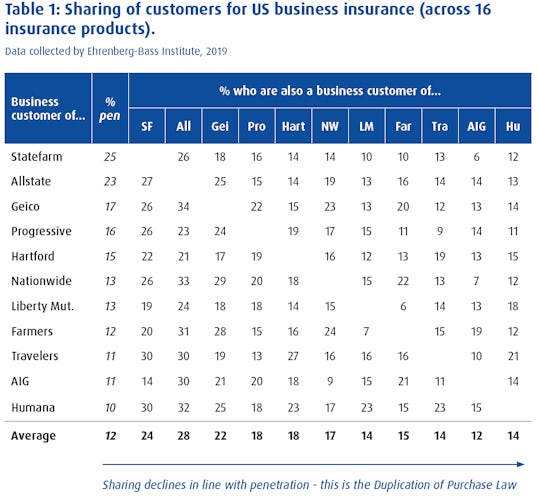
On average, 24% of customers at any company in the market will also have a policy with Statefarm, the insurance business with the highest penetration. At the other end of the scale, just 14% of a company’s customers will be shared with Humana, the business with the lowest penetration.
“The duplication of purchase law tells us how we compete with other brands in the competitive market,” Romaniuk explains to Marketing Week.
“What it tells us is that it doesn’t so much matter what our positioning is, or what products we sell. If we’re competing in a market with a brand, then how they are as a competitor is really related to their size. We will share more of our customers with bigger competitors and fewer of our customers with smaller competitors.”
Read full article in Marketing Week.