
Buyer says no? The rejection of Generative AI brands in B2B
B2B Report August 2025
Authors - Jenni Romaniuk & Lara Stocchi
Brand rejection is a refusal to buy/use the brand or company. Different from non-buying rejection is an active objection, which can become a barrier to purchase. In the Generative AI space developing a wide customer base is crucial to stimulate further investment. Company rejection hurts current sales and can create a barrier to trialing any new iterations. This can stifle customer-base growth, even if the company’s future technology leapfrogs over competitors.
Summary
Brand rejection is a refusal to buy/use the brand or company. Different from non-buying rejection is an active objection, which can become a barrier to purchase. In the Generative AI space developing a wide customer base is crucial to stimulate further investment. Company rejection hurts current sales and can create a barrier to trialing any new iterations. This can stifle customer-base growth, even if the company’s future technology leapfrogs over competitors.
Findings
In this research we benchmarked the level of brand rejection for 20 companies offering Generative AI products, and we identified the reasons for rejection. Across 2,835 professional users of Generative AI in 13 countries, we find:
Companies offering Generative AI have an average 6% rejection rate, with 90% of rejection levels under 10% (out of 260 observations). The maximum rejection reached is 15% (for a B2B data analytics vendor in Germany). Therefore, even the worst case in our data has 85% of the users not rejecting the company.
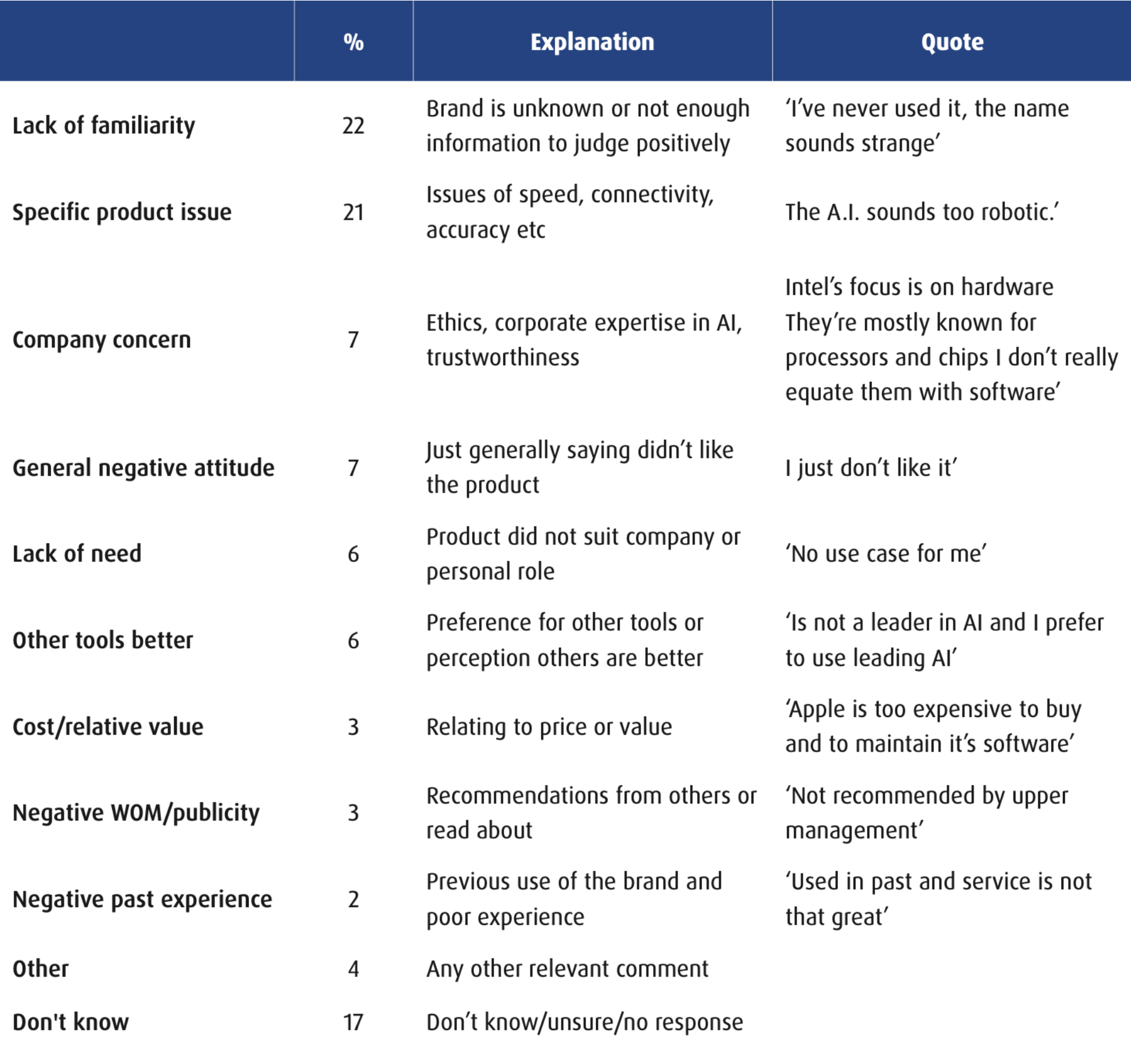
Lack of familiarity was the most common reason for rejection (22%), which means lack of company knowledge did not stimulate curiosity, but rather rejection. You can’t assume buyers will go looking for you if you don’t make it easy for them to build the right memories about your company. They may just cross your company off the list instead.
Rarely were companies rejected because of cost, or negative WOM or negative publicity, each with 3% or lower responses (see Table A).
More business GenAI users are unaware, or have no opinion of a brand, rather than actively reject it. We also find even the biggest brands and companies have more users with no opinion, rather than active rejectors.
If we compare the percentage of the who responded ‘unaware/have no opinion’ against those who chose ‘I would refuse this brand’, the former is always higher. For big brands, it is around 30-90% higher, while for smaller brands it is up to 200-300% higher.
For example, company level unaware or no opinion to rejection ratios ranged from 1.3 for the biggest brand to 3.9 for the smallest. This means that the biggest brand, even though it is widely known in this space, still has 30% more business users of Generative AI who were unaware of it or had no opinion of the company than people rejecting its AI offerings. For smaller brands, this trend is even more prominent; for example, with up to has 290% more ‘unknowns’ than ‘rejectors’.
Therefore, there is more upside in building mental availability, than there is in trying to address stated reasons for rejection. This upside is further amplified by the fact that mental availability building activities will also likely positively impact the remainder 40% to 62% who are ‘in market’ and can be acquired. Trying to reverse reasons for rejection will lead to you to focus on issues only relevant for a small proportion of potential buyers, and/or risk magnifying a small issue by raising it to many more others.
Table 1: Ratio of no opinion/unaware versus rejectors of Generative AI tools from different companies
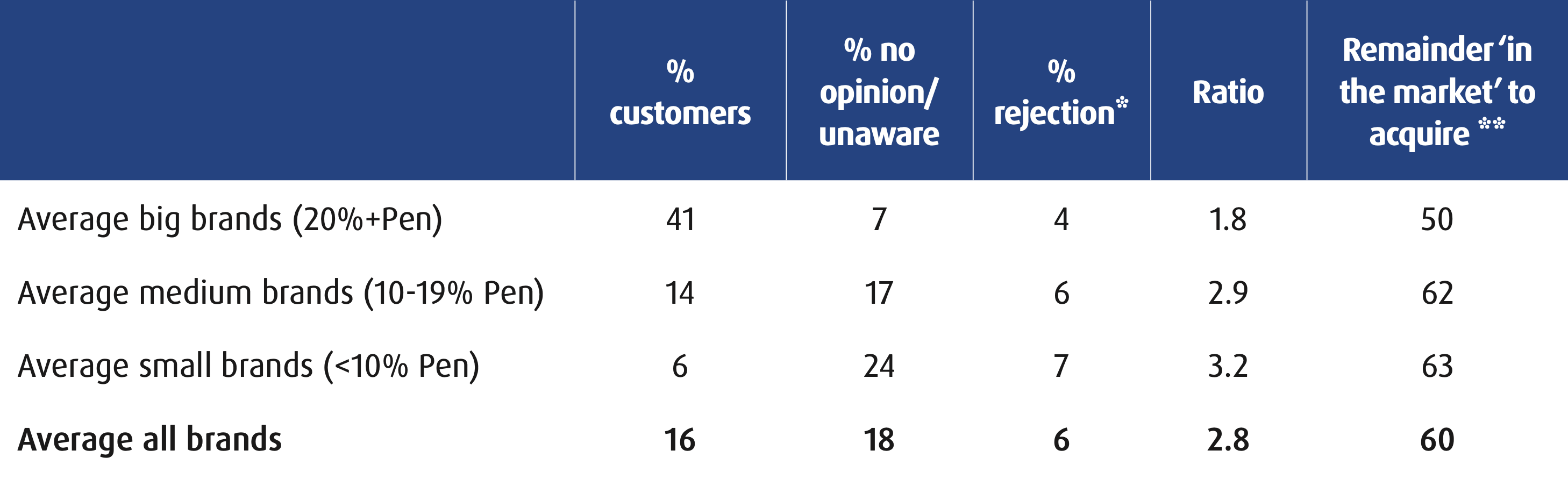 *note rejection and no opinion/unaware is related to its Generative AI tool
**’in market’ is the proportion of non-buyers who are not current customers, but neither reject the company or are unaware/have no opinion about the company.
Technical Notes
Brand rejectors were identified by the response ‘I would refuse to buy/use this brand’ to a five part attitude question. Reasons for rejection were collected as a follow up open-ended questions (‘Why would you refuse to use <insert brand>?’, with verbatim responses coded into 12 themes (see Table A).
The low levels of rejection are not due to user apathy, as 43% rejected at least one company offering Generative AI out of the 20 provided, it is just uncommon for any specific company to be rejected. This also means 57% did not reject any of the 20 companies listed.
Table A: Reasons for Generative AI company rejection
Technical Notes
Brand rejectors were identified by the response ‘I would refuse to buy/use this brand’ to a five part attitude question. Reasons for rejection were collected as a follow up open-ended questions (‘Why would you refuse to use <insert brand>?’, with verbatim responses coded into 12 themes (see Table A).
The low levels of rejection are not due to user apathy, as 43% rejected at least one company offering Generative AI out of the 20 provided, it is just uncommon for any specific company to be rejected. This also means 57% did not reject any of the 20 companies listed.
The Ehrenberg-Bass Institute specialise in research services that are underpinned by robust evidence. Explore these services and how they can fit within your organisation.