From mental availability to mass marketing, purpose nonsense and consistency: What Ritson and Sharp did and didn’t agree on at this year’s Cannes
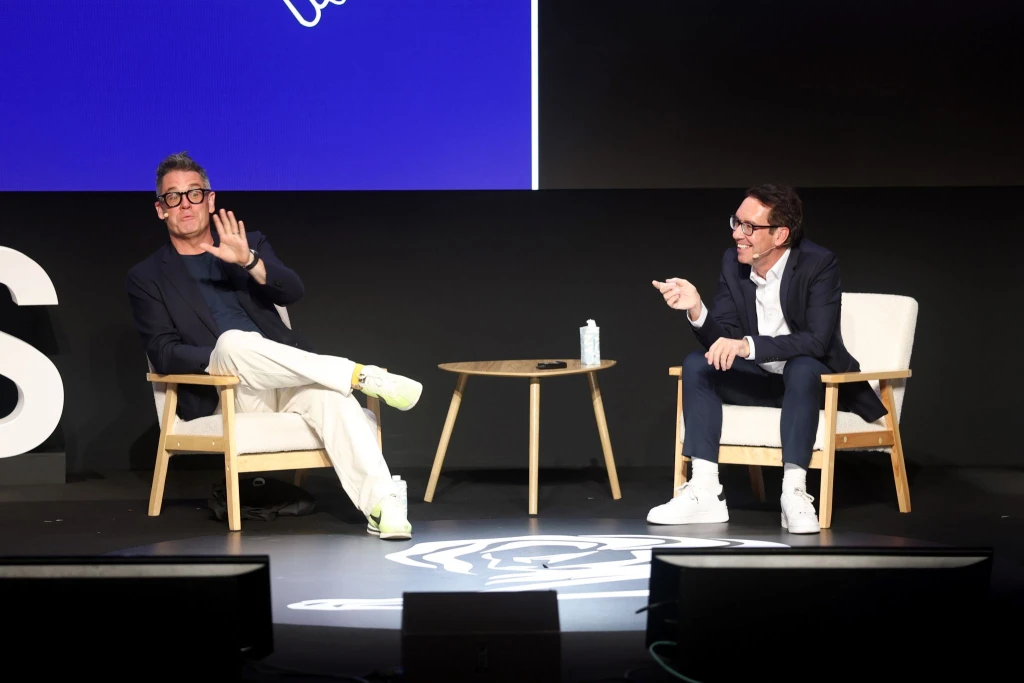
Ritson agreed to meet Sharp most of the way and rename his MiniMBA course modules on ‘brand codes’ to ‘distinctive brand assets’ to stop “confusing the fuck out of young marketers” with these terms. Both luminaries are happy to agree that sophisticated mass marketing is necessary, and on the 95:5 ratio between latent and available customers in market, although Ritson’s pushing for the last 5 per cent of short-term activation to be called targeting, while Sharp describes it as purchase availability. And the pair share consensus that consistency is critical and the campaign cake needs to cook for longer, yet also believe marketers are shockingly bad at sticking to the recipe. At this year’s Cannes Lions Festival, Ritson and Sharp joined each other onstage to share a moment of camaraderie while proving there’s still plenty of debate, nuance and ribbing to be had in how marketing effectiveness is truly achieved.
The session was called ‘Five Marketing Truths We Can Actually Agree on’ and brought two of the most outspoken thinkers in marketing who aren’t exactly known for the consistency of messaging between them: Mark Ritson and Ehrenberg-Bass Institute chief, Professor Byron Sharp. And for about half of the discussion, the pair did share consensus on several tentpole ideas of modern marketing, from mental availability and the need for distinctive brand assets, to sophisticated mass marketing and the desperate need for marketers to run campaigns for longer – not for the average 30-40 days, but years.
Yet the fireside chat between Ritson and Sharp was equally a lesson in the fact that there’s still plenty of live debate on what actually makes marketing effective – and indeed, what marketing does and is. And with sessions around them dominated by the subject of AI and the duality of machine / human audiences marketers now have to pitch their wares to, it’s also clear the ways marketing looks to persuade by tapping human connection through insight, creative effectiveness and emotion are up for fresh debate as machines do the engaging for us.
Mental availability
The top ‘truth’ Ritson and Sharp both agreed to was marketers need to build mental availability – what was dubbed ‘brand salience’ in Ehrenberg-Bass’ original language.
“It was a terrible name – people thought it was top of mind awareness, and it wasn’t, or anything to do with a single cue,” Sharp said. “This is one of the big shifts in marketing: From worrying about what does our brand mean and what does it evoke, to we’re in a big world and what evokes the brand being vastly more important to marketers.”
Ritson noted the US model of marketing previously saw awareness as the gateway to brand image, emotions and relationships – what people feel about your brand. And wrongly, that it’s a one-off battle to be won, Sharp added.
“What Ehrnenberg-Bass brought to us with mental availability is the understanding that most of your job as a marketer is just having that brand come to mind,” Ritson said. “My bullshit number: If your brand will come to mind in those buying situations, and if you’re mentally available, 70-80 per cent of your job has been done, partly because you’re in the game, and partly because consumers are lazy. Once they’ve got your brand in their head, they’re starting to make arguments inside their brains as to why yes, you are this or that. It was a revolution to me to accept that idea that it’s mostly about your brand coming to mind.”
It also holds in B2B and durables, the pair noted. “The data that Professor John Dawes [from Ehrenberg-Bass Institute] and his team have done shows that the first brand you think of when you think of corporate law or infrastructure or logistics, is 70 per cent of the time the one that you will be buying with your B2B decision-making team. Salience Uber Alles is how I like to put it,” said Ritson.
Yet where nuances came out in the discussion were differentiation versus distinctiveness. Distinctiveness feeds mental availability, Ritson said, but he also argued for “relative differentiation” – not uniqueness – on top. Sharp saw that as positioning.
“But the big story there, though, is just how shockingly low it is,” Sharp said. “And how little it matters.
“We did a lot of pricing research over the decade, and one of the things in that was we wanted really differentiated brands in the experiment. When we looked, we saw that in everything – different flavours, pack size. But stick them in experiments with consumers and they just don’t believe it is. The only one that was organic, gluten-free, was the only one that could cause some behaviour shift.
“If you need complicated market research to torture data to find your differentiation, you haven’t got any.”
Distinctive brand assets
Which fed into another common ground: The need for distinctive brand assets, codes and fluency. “This came from my presentation, ‘branding matters’, but not for the reason you think it was,” Sharp recalled. “That’s all this was: Branding. One misconception is that it’s about being green when everyone else is purple. It’s not, it’s just looking like you. That might be light beige, as long as people identify it as you.”
Per Ritson, citing Sharp: “A brand that looks like itself”.
“If you accept our first point we both agree on … then the main route in many cases is having a palette of distinctive brand assets, logo plus three or four things,” he continued. “To use my language now, rather than Byron’s, you then have to codify the shit out of everything you do.
Read the full article in Mi3.